Tuesday

June 19, 1875

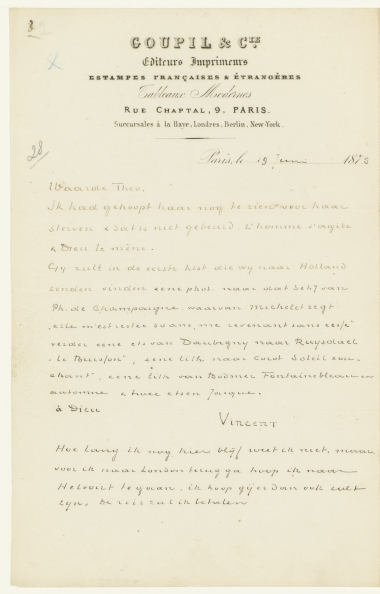
[Letterhead: Goupil Paris]

Paris, 19 June 1875

My dear Theo,

I had hoped to see her again before she died, and that didn’t happen. Man proposes and God disposes.


In the first crate we send to Holland you’ll find a photo of that painting by P. de Champaigne, of which Michelet said, ‘she stayed with me for 30 years, coming back to me incessantly’, also an etching by Daubigny after Ruisdael’s ‘Bush’, a lithograph after Corot’s ‘Sunset’, a lithograph by Bodmer, ‘Fontainebleau in the autumn’ and two Jacque etchings.


Adieu

Vincent

I don’t know how long I’ll be staying here, but before I return to London I hope to go to Helvoirt. I hope you’ll be there too. I’ll pay for the journey.

You certainly won’t forget her and her death, but keep it to yourself. This is one of those things that, little by little, makes us ‘sorrowful, yet always rejoicing’; and that we must become.


Sunday

May 31, 1875

[Letterhead: Goupil Paris]

Paris, 31 May 1875

My dear Theo,

Thanks for your letter of this morning.

Yesterday I saw the Corot exhibition. It included a painting of the ‘Mount of Olives’; I’m glad he painted that.

On the right, a group of olive trees, dark against the darkening blue sky; in the background hills covered with shrubs and a couple of tall trees, above them the evening star.

There are 3 Corots at the Salon, very beautiful, the most beautiful one, painted shortly before his death, ‘Women cutting wood’, will probably appear as a woodcut in L’Illustration or Le Monde Illustré.

I’ve also seen the Louvre and the Luxembourg, as you can imagine.

The Ruisdaels in the Louvre are magnificent, especially ‘The bush’, ‘The breakwater’ and ‘The ray of sunlight’.


I wish you could see the small Rembrandts there, the ‘Supper at Emmaus’, and two pendants, ‘The philosophers’.

I recently saw Jules Breton with his wife and two daughters. Physically he reminded me of J. Maris, though he has dark hair.

When I have the chance I’ll send you a book of his, ‘Les champs et la mer’, which contains all his poems.

He has a beautiful painting at the Salon, ‘The feast of St John’, peasant girls dancing on a summer evening round the St John’s bonfire, in the background the village with its church and the moon above it.

Dance, young maidens, dance,
As you sing your songs of love!
Tomorrow, at break of day,
You’ll go, hastening to ply your sickles.

There are now 3 paintings by him in the Luxembourg. ‘Procession through a cornfield’, ‘Women gleaning’ and ‘Alone’.


Adieu

Vincent

Saturday

May 8, 1875

London, 8 May 1875

My dear Theo,

Thanks for your last letter. How is the patient? I’d already heard from Pa that she was ill, but I didn’t know that it was as bad as you said.

Write to me about this soon, if you will. Yes, old boy, ‘what shall we say?’

C.M. and Mr Tersteeg were here and left again last Saturday. In my opinion they went a little too often to the Crystal Palace and other places that didn’t concern them. It seems to me they could also have come and seen where I lived.

You ask about Anna, but we’ll discuss that another time.

I hope and believe that I’m not what many think me to be at present, we’ll see, we have to give it time; people will probably say the same about you in a couple of years; at least if you continue to be what you are: my brother in two senses of the word.

Regards, and my regards to the patient. With a handshake,

Vincent


To act on the world one must die to oneself. The people that makes itself the missionary of a religious thought has no other country henceforth than that thought.

Man is not placed on the earth merely to be happy; nor is he placed here merely to be honest, he is here to accomplish great things through society, to arrive at nobleness, and to outgrow the vulgarity in which the existence of almost all individuals drags on.

Renan

Between 13 and 18 April, 1875

London, April 1875


My dear Theo,

I’m sending you herewith a small drawing. I made it last Sunday, the morning a daughter (13 years old) of my landlady died.

It’s a view of Streatham Common, a large, grass-covered area with oak trees and broom.

It had rained in the night, and the ground was soggy here and there and the young spring grass fresh and green.

As you see, it’s scribbled on the title page of the ‘Poesies d’Edmond Roche’.

There are beautiful ones among them, serious and sad, including one that begins and ends

Sad and alone, I climbed the sad, bare dune,
Where the sea keens its ceaseless moaning plaint,
The dune where dies the wide unfurling wave,
Drab path that winds and winds upon itself again.

and another, ‘Calais’

How I love to see you once again, o my native town,
Dear sea nymph seated at the waters’ edge!
I love the soaring spire of your bell-tower,
Lovely in its boldness and its elegance,
Its fretted cupola, through which we see the sky.


You’ll probably be curious about what goes with the etching by Corot and so I’ve copied that out as well.

The pond
to Corot

We watched the pond, its water leaden, drear,
Form crease upon crease slowly in the breeze,
And the mud, enfolding in a softened line
The prow and black sides of a boat aground;

The woods’ high crown, leaf by fallen leaf,
Lay strewn upon the ground; the sky was filled with mist;
We two, in whispers, almost furtively,
Were sadly saying, ‘Summer’s past:

These slopes have lost their accustomed grace;
No more green foliage, no more golden light
Trembling in the trembling water or touching tops with gold!’

This idyll may yet come before our eyes again,
If you would have it so: are you not the master
Who re-created it after its first creator’s hand?

Ville-d’Avray


Warm regards, and I wish you the best. Adieu

Vincent

Thursday

April 6, 1875

[Letterhead: Strand London]


6 April 1875


My dear Theo,

Thanks for your letter. Didn’t I copy out Meeresstille by Heine in your little book?1 Some time ago I saw a painting by Thijs Maris that reminded me of it.

An old Dutch town with rows of brownish red houses with step-gables and tall flights of steps, grey roofs, and white or yellow doors, window-frames and cornices; canals with ships and a large white drawbridge, a barge with a man at the tiller going under it. The little house of the bridge-keeper, whom one sees through the window, sitting in his office.

Some distance away a stone bridge over the canal, with people and a cart with white horses crossing it.

And everywhere movement, a porter with his wheelbarrow, a man leaning against the railing, gazing into the water, women in black with white caps.

The foreground a quay with paving-stones and a black railing.

In the distance a tower rises above the houses.

A greyish white sky over everything.

It’s a small painting, upright. The subject is nearly the same as the large J. Maris, Amsterdam, which you perhaps know, only this is talent and the other is genius.

I’ve again copied out one or two things for you, which I’ll send when I get the chance.

Think of ‘The cliff’ and whether you know of anything else. That Victor Hugo piece is beautiful.


Adieu, give my regards to Pa if you see him.


Vincent

Tuesday

March 6, 1875

[Letterhead: Strand London]


6 March 1875


My dear Theo,

Bravo Theo – You well understood that girl in Adam Bede. That landscape – in which a dull yellow sandy road leads over the hill to the village, with mud or whitewashed huts with green, moss-covered roofs and here and there a blackthorn, on either side brown heather and bunt and a grey sky, with a narrow white strip above the horizon – is by Michel. Except that the atmosphere is purer and nobler than in Michel.

Today I’m enclosing that little book for you in the crate to be sent. Also Jesus by Renan and Jeanne d’Arc by Michelet, and also a portrait of Corot, from the London News, which I also have hanging in my room.

I don’t believe there’s any chance that you’ll be transferred to the London branch for the time being.
Don’t feel bad because you’re not finding things difficult; I have it easy, too. I believe that life is quite long, and the time when ‘another shall gird thee, and carry thee whither thou wouldest not’ will come of its own accord. Adieu, give my regards to everyone I know.

With a handshake,


Vincent

Friday

February 1875

My dear Theo,


I’ve filled your little book and I believe it’s turned out well. Send me The cliff by Jules Breton when you get the chance.


Our gallery is now finished and it’s beautiful, we have many beautiful things at the moment: Jules Dupré, Michel, Daubigny, Maris, Israëls, Mauve, Bisschop, &c. We’re going to hold an exhibition in April. Mr Boussod has promised to send us the best that can be had: Malaria by Hébert, The cliff by J. Breton, &c.


I’d like so much to have you here, we must make sure that it happens sometime. I’d like so much to show you my room &c. There’s a beautiful exhibition of old art here, including a large Descent from the Cross by Rembrandt, 5 large figures at twilight, you can imagine the sentiment. 5 Ruisdaels, 1 Frans Hals, Van Dyck. A landscape with figures by Rubens, a landscape, an autumn evening, by Titian. 2 portraits by Tintoretto and beautiful old English art, Reynolds, Romney and Old Crome, landscape, magnificent.


Adieu, I’ll send your little book at the first opportunity. Write to me soon.


Vincent

August 10, 1874

Letter From Vincent to Theo.

Dear Theo,

“Ye judge after the flesh; I judge no man.”

“He that is without sin among you, let him cast a stone at her.”

So keep to your own ideas, and if you doubt whether they are right, test them with those of Him who dared to say, “I am the truth,” or with those of some very human person, Michelet, for instance…

Virginity of soul and impurity of body can go together. You know the “Margaret at the Fountain,” by Ary Scheffer, is there a purer being than that girl “who loved so much”?

“Leys n'est pas un imitateur mais un semblable” [Leys is not an imitator but a similar one] is a true saying that struck me too. One might say the same of Tissot's pictures, of his “Walk in the Snow,” “Walk on the Ramparts,” “Marguerite in Church,” etc.

With the money I gave you, you must buy Alphonse Karr's Voyage autour de mon jardin. Be sure to do that - I want you to read it.

Anna and I walk every evening. Autumn is coming fast and that makes nature more serious and more intimate still. We are going to move to a house quite covered in ivy; I will soon write more from there. Compliments to anyone who may inquire after me.

Vincent

Tuesday

July 31, 1874

Letter From Vincent to Theo.

Dear Theo,

I am glad you've been reading Michelet and that you understand him so well. If that kind of book teaches us anything it is that there is much more to love than people generally suppose. To me, that book has been both a revelation and a Gospel.

'Il n'y a pas de vielle femme!'[There are no old women.] (That does not mean that there are no old women, only that a woman does not grow old as long as she loves and is loved.) And then a chapter like “The Aspirations of Autumn,” how rich that is … That a woman is a 'quite different being' from a man, and a being that we do not yet know, or at best only superficially, as you put it, yes, that I am sure of. And that a man and a woman can become one, that is to say, one whole and not two halves, I believe that too.

Anna is bearing up well, we go on marvellous walks together. It is so beautiful here, if one just has a good and single eye without too many beams in it. And if one does have that eye, then it is beautiful everywhere.

Father is far from well, although he and Mother say that he's better. Yesterday we received a letter with all sorts of plans (wouldn't we just try this and that) which will prove to be unworkable and certainly useless and at the end Father said once again that he leaves it all to us, etc., etc. Rather petty and disagreeable, Theo, and it reminded me so much of Grandfather's letters, but qu'y faire [What can you do?]. Our beloved Aunts are staying there now and are no doubt doing much good! Things are as they are and what can a person do about it, as Jong Jochem said.

Anna and I look at the newspaper faithfully every day and reply to whatever advertisements there are. On top of that we have already registered with a Governess agency. So we are doing what we can. More haste less speed.

I'm glad that you go round to see the Haanebeeks so often, give them all my kindest regards and tell them some of my news.

The painting by Thijs Maris that Mr. Tersteeg has bought must be beautiful, I had already heard about it and have myself bought and sold one quite similar.

My interest in drawing has died down here in England, but maybe I'll be in the mood again some day or other. Right now I am doing a great deal of reading

On 1st of January 1875 we shall probably be moving to another, larger shop. Mr. Obach is in Paris at the moment deciding whether or not we should take that other firm over. Don't mention it to anybody for the time being.

Best wishes and write to us again soon. Anna is learning to appreciate paintings and has quite a good eye, admiring Boughton, Maris and Jacquet already, for instance, so that is a good start. Entre nous, I think we are going to have a difficult time finding something for her, they say everywhere that she is too young, and they required German, too, but be that as it may, she certainly has a better chances here than in Holland. Goodbye,

Vincent

You can imagine how delighted I am to be here together with Anna. Tell H. T. [Herman Tersteeg] that the pictures have duly arrived and that I shall be writing to him soon.

Saturday

July 21, 1874

Leter from Vincent to Theo.

Dear Theo,

Yesterday a box was sent to The Hague, in which I enclosed a photograph of a picture by J. Maris and also, as I promised, “Der Wirthin Töchterlein.” I hope you will put them both up in your room. In the same box is a photograph of a picture by Thijs Maris, for Mr. Tersteeg. Schüller in Paris sent me six copies of both, which I needed for presents; I have none to spare of the Thijs Maris.

Anna and I arrived safely in London and hope we shall find something for her here. I do not say it will be easy, but every day she is here she learns something, and at all events I think there is more chance for her to find something here than in Holland. It is a great pleasure for me to walk with her through the streets in the evening. I find everything again as beautiful as when I saw it the first time. Good luck to you, boy, and give my compliments to the Rooses, Haanebeeks and Carbentuses when you see them. I am learning to swim.

Write to me whether you have already read in Michelet and what you think about it. To me that book was a revelation. À Dieu.

Vincent

Tuesday

July 10, 1874

Letter from Vincent van Gogh to Theo van Gogh

Helvoirt

Dear Theo,

Thanks for the inquiry you made. We are now going to stay here another day and arrive in London on Wednesday morning. The photograph that I put in the catalogue of Forbes was for you, as I thought it would interest you: it represented the Scheldt in Belgium. It is of a picture by Cap. It is not so very beautiful, but it is at least original. I will write soon from London.

Best wishes from Vincent

Saturday

June 16, 1874

Letter from Vincent van Gogh to Theo van Gogh

London

Dear Theo,

Thanks for your letter. I intend to leave here on Thursday, June 25, or Saturday, June 27, if nothing interferes. I am longing so much for everybody and for Holland. I am also anxious to have a good talk with you about art; think it over and perhaps you will have some questions to put to me. We have many beautiful things here, including a fine picture by Jacquet and a beautiful Boldini.

There are beautiful things in the Royal Academy this year. Tissot has three pictures there. Lately I took up drawing again, but it did not amount to much.

I was glad to see from your letter that you often visit the Haanebeeks. À Dieu, we shall meet soon. My compliments to all the friends.

Ever your brother, Vincent

I am glad you like César de Cock so much; he is one of the few painters who understands our dear Brabant intimately. I do not know if I told you that I met him in Paris last year.

Monday

April 30, 1874

Letter from Vincent van Gogh to Theo van Gogh

London

Dear Theo,

Many happy returns of your birthday, “Do well and don't look back, then all will come right.”

I was glad to receive your last letter. A few days ago I sent you a photograph, “Young Girl with a Sword” by Jacquet, as I thought you would like to have it.

The picture by Van Gorkom is not very dirty. (Entre nous, I have not seen it, but tell him I said it was not very dirty.) How are Mauve and Jet? Tell me about them.

I am glad you visit the Haanebeeks often. When I return to Holland, I will stop for some days in The Hague, because for me The Hague is like a second home to me. (I will stay at your place.)

I would have liked to accompany you on this walk to the Vink. I seize every opportunity to make a tour of the area but, for the moment, I am very busy. It is very beautiful here (although it is in the city). Lilac, hawthorns and laburnums flower in all gardens; the chestnut trees are splendid.

He that sincerely loves nature, finds pleasure everywhere. Nevertheless I miss Holland, especially Helvoirt.

I am very busy gardening now, I have sown scented peas, poppies and daisies; I have nothing more to do than to wait to see what they will give.

I have to tell that I am happy every morning to have to walk the distance between my accommodation and the shop and, in the evening, that between the shop and my accommodation, it is a good three-quarters of an hour walk each time.

It is a fine thing that business finishes so early; the office closes at six o'clock, and yet there is no less work done. My compliments to all the friends, especially to Tersteeg, Haanebeek and Carbentus, also to everyone at Uncle Pompe's because they are going to Kampen, and to Mr. Bakhuyzen. Best wishes.

Vincent

The apple trees have blossomed beautifully; I think everything is earlier here than in Holland.

As soon as I know anything more definite about my going home, I shall write at once. I am afraid, however, that I shall not be able to go for at least four weeks. Write soon.

Friday

March 30, 1874

Letter from Vincent van Gogh to Theo van Gogh

London

Dear Theo,

I have received your gift, included in a letter to me, of a guilder intended for the purchase of a pair of cuff links. I thank you very cordially, old man, but you should not have, I have more money than necessary.

Thanks for the letter which I received this morning. I was very glad to hear that Mauve is engaged to Jet Carbentus. That is fine…I was pleased to hear that you are doing so well.

You have done well to read the book by Burger; you should devour books on art as much as possible, especially The Gazette de Beaux-Arts, etc. By all means try to get a good knowledge of pictures. That picture by Apol we have here now is good, but last year he painted the same subject and I thought it was better and brighter than this one.

I am glad that you go to see Uncle Cor now and then; he has pictures and prints which you can never see at the house in The Hague.

I, too, am very busy just now and am glad of it, for that is what I want. À Dieu, boy, keep in good spirits. I wish you well. Greetings to Iterson.

Vincent

Saturday

March 3, 1874

Letter from Vincent van Gogh to the Van Stockum - Haanebeek family

London

Dear Carolien and Willem,

Hearty congratulations.

I am afraid you are disappointed at not hearing from me sooner, but that's how I am, and you know that I mean well. But now you must return good for evil, and let me know at once how you are.

Now I have something new to tell you; perhaps our Anna will come here. You can well imagine how wonderful this would be for me. It is almost too good to be true. Well, we'll have to wait and see. If she comes, it will probably be in May; and perhaps it might be arranged for me to go and bring her back. I am longing to be closer to her than I am now. We have hardly seen each other once these last few years, and we only half know each other.

The best of luck to you, greetings to all in the Poten, and to anyone who asks after me.

Have you kept up your acquaintance with the Tersteeg family?

Yours truly, Vincent

February 24, 1874

Letter from Anna Van Gogh to Theo van Gogh

Zundert

I also got a very kind letter from Eugénie; she seems to be a natural and amiable girl. Vincent wrote that she was engaged, with a good natured youth who would know to appreciate her…We two are just [like] old people who try to know all about persons who are in love. But I am very glad for Vincent that he found such a kind family to live [with], you know yourself how agreeable it is. He seems to be always in good spirits. In the last letter he writes to me: “I fear that after all the sunshine I enjoy from there could be very soon rain - but I will only enjoy as long as possible the sunshine and have my umbrella in the neighbourhood for the rain that could come.”

Tuesday

February 20, 1874

Letter from Vincent van Gogh to Theo van Gogh

London

Dear Theo,

Thanks for your letter. I don't want the book just now; take your time and send it back when you have finished it. I have not read the book by Van Vloten, but I should like to see it. I have read another book on art by Van Vloten, and did not quite agree with him, though it was very learned. Burger is simpler, and whatever he says is true.

I am glad you have been in Amsterdam. When you see him, will you thank Uncle Cor for the pamphlet he sent me? I am glad you feel so comfortable at Roos's. As I already let you know through Anna Carbentus, you are quite right about those priggish girls. I also agree with you about Bertha Haanebeek; but watch your heart, boy.

Have you seen Mr. Jacobson's collection yet? He will certainly ask you to come to see it, and it is well worth while. Give him my respects and tell him I am doing quite well here and that I see many beautiful things.

I am all right and am very busy. Thank Willem for his letter and greet everybody at Roos's and Iterson and anybody who may ask after me. Best regards.

Vincent

Friday

February 9, 1874

Letter from Vincent van Gogh to Carolien

London

My dear Carolien,

I feel the urge to write you a few words. How nice were the days “wenn wir zusammen waren”; rest assured that I never forget you, but I am not such a good hand at letter-writing as I should like to be. I live a rich life here, 'having nothing yet possessing all.' At times I am inclined to believe that I am gradually turning into a cosmopolite; that is, neither a Dutchman, nor an Englishman, nor yet a Frenchman, but simply a man. And as a homeland, the whole world, i.e. a small spot in the world where we are sent to stay. We have not got there yet, though I am straining after it, and perhaps may grasp it. And as my ideal, what Mauve called, “That is it.”

Old girl, à Dieu.

Yours truly, Vincent

A handshake for you and Willem, like old times, till your fingers hurt.

Monday

January 15, 1874

Letter from Vincent van Gogh to Theo van Gogh.

London.

Many thanks for your letter. My warm good wishes for a very happy New Year. I know you are doing well at The Hague, because Mr. Tersteeg told me so. I can see from your letter that you are taking a keen interest in art, and that's a good thing, old fellow. I'm glad you like Millet, Jacque, Schreyer, Lambinet, Frans Hals, etc., for as Mauve says, “That's it.” That painting by Millet, L'angélus du soir, “that's it,” indeed - that's magnificent, that's poetry. How I wish I could have another talk with you about art; but we'll just have to keep writing to each other about it. Admire as much as you can; most people don't admire enough.

Here are the names of a few the painters I particularly like. Scheffer, Delaroche, Hébert, Hamon, Leys, Tissot, Lagye, Boughton, Millais, Thijs [Matthijs] Mans, De Groux, De Braekeleer, Jr., Millet, Jules Breton, Feyen-Perrin, Eugène Feyen, Brion, Jundt, George Saal, Israëls, Anker, Knaus, Vautier, Jourdan, Jalabert, Antigna, Compte-Calix, Rochussen, Meissonier, Zamacois, Madrazo, Ziem, Boudin, Gérôme, Fromentin, de Tournemine, Pasini, Decamps, Bonington, Diaz, Th. Rousseau, Troyon, Dupré, Paul Huet, Corot, Jacque, Otto Weber, Daubigny, Wahlberg, Bernier, Émile Breton, Chenu, César de Cock, Mile. Collart, Bodmer, Koekkoek, Schelfhout, Weissenbruch, and last [but] not least, Maris and Mauve.

But I could carry on like that for I don't know how long, and then there are still all the old masters, and I am sure I have forgotten some of the best of the modern ones.

Do go on doing a lot of walking and keep up your love of nature, for that is the right way to understand art better and better. Painters understand nature and love her and teach us to see.

And then there are painters who never do anything that is no good, who cannot do anything bad, just as there are ordinary people who can do nothing but good.

I'm getting on very well here. I've got a delightful home and I'm finding it very pleasurable taking a look at London and the English way of life and the English people themselves, and then I've got nature and art and poetry, and if that isn't enough, what is? But I haven't forgotten Holland and especially not The Hague and Brabant.

We are busy at the office doing stocktaking, but it will all be over in 5 days, we got off more lightly than you did in The Hague.

I hope that, like me, you had a happy Christmas.

And so, my boy, best wishes and write to me soon, Je t'écris un peu au hasard ce qui me vient dans ma plume, I hope you'll be able to make something of it.

Goodbye, regards to everybody at work and to anybody else who asks after me, especially everybody at Aunt Fie's and at the Haanebeeks'.

Vincent

I am enclosing a few lines for Mr. Roos.
Saturday

January 6, 1874

[Unpublished Letter from Anna van Gogh to Theo]

Leeuwarden,

6 January 1874

Monday morning at breakfast I found a letter from London, which contained a letter from Vincent and one from Ursula Loyer, both were very kind and amiable. She asks me to write her and Vincent wished very much we should be friends. I'll tell you what he writes about her: “Ursula Loyer is a girl with whom I have agreed that we should consider ourselves each other's brother and sister. You should consider her as a sister too and write to her, and I think you will then soon find out what kind of girl she is. I'll say nothing more than that I never heard or dreamed of anything like the love between her and her mother…Old girl, don't think there is more behind it than I wrote just now, but don't tell them at home; I must do that myself. But again: Love her for my sake.” I suppose there will be a love between those two as between Agnes and David Copperfield. Although I must say that I believe there is more than a brother's love between them, I send you here Ursula's letter and so you can judge for yourself. I hope you will send it back very soon with a long epistle of yourself.